

Who Should Not Do Hot Yoga? Critical Contraindications & Safety Rules
Having spent the last decade managing busy hot yoga studios and teaching back-to-back classes in rooms heated to 105°F, I’ve had to assist students experiencing everything from mild dizziness to severe heat exhaustion. In our studios, we place student safety above all else, which means having honest—and sometimes difficult—conversations about who should not do hot yoga. While heated practice offers incredible cardiovascular and flexibility benefits for most people, the extreme thermal load is a serious physiological stressor. If you have pre-existing cardiovascular conditions, are pregnant, or suffer from specific autonomic nervous disorders, stepping into a heated room can be dangerous. In this guide, we’ll outline the absolute medical contraindications, relative risks, and safety parameters you must consider before unrolling your mat.
Too often, marketing materials promote hot yoga as a universal cure-all. But the reality of a 105°F ($40.6^\circ\text{C}$) room with 40% humidity is that it places a significant load on your heart, blood vessels, kidneys, and thermoregulation systems. For a healthy individual, this stressor stimulates adaptation, building cardiovascular resilience. However, for someone with an underlying condition, this same environment can cause acute injury. Let’s look at the science-backed absolute contraindications, relative risks, and critical warning signs that mean hot yoga is not suitable for you.
Absolute Medical Contraindications: Who Must Avoid Hot Yoga Entirely
If you have any of the following conditions, you should not practice hot yoga under any circumstances. These are considered absolute contraindications by exercise physiologists and medical professionals:
1. Severe Cardiovascular Disease
When you enter a hot room, your blood vessels dilate, causing blood pressure to drop. To compensate and maintain blood flow to vital organs, your heart rate increases dramatically, and the heart pumps more blood per beat (stroke volume). If you have uncontrolled hypertension, congestive heart failure, a history of heart attack or stroke, or moderate-to-severe heart valve disease, your cardiovascular system cannot safely meet this double demand. This can trigger cardiac arrhythmia, chest pain (angina), or a cardiac event.
2. Pregnancy (Especially the First Trimester)
During pregnancy, maternal core temperatures exceeding 102.2°F (39°C) are linked to a higher risk of fetal neural tube defects and developmental complications. Because a fetus cannot regulate its own temperature and relies entirely on maternal cooling, exposing your body to a 105°F environment is an unnecessary risk. Additionally, the hormone relaxin is highly active during pregnancy, softening ligaments to prepare the pelvis for birth. The combination of heat and relaxin makes it extremely easy to over-stretch and permanently damage joint structures.
3. Impaired Thermoregulation (Anhidrosis)
If your body cannot produce sweat normally, you should not do hot yoga. Anhidrosis (the inability to sweat) prevents your body from cooling itself through evaporation. Without this cooling mechanism, your core body temperature will rise rapidly, leading to heat exhaustion or life-threatening heat stroke within minutes of entering a heated room.
4. Autonomic Neuropathies (POTS)
Postural Orthostatic Tachycardia Syndrome (POTS) affects your body’s ability to regulate blood flow. In a heated room, vasodilation causes blood to pool in your lower extremities. When you transition from a fold to a standing position, your heart rate spikes abnormally to keep blood flowing to your brain, resulting in severe dizziness, palpitations, and fainting (syncope).
Relative Contraindications: Proceed Only with Doctor Clearance
Some conditions do not carry an absolute ban but require a formal consultation with your doctor and modifications to your practice. If you fall into these categories, proceed with extreme caution:
- Controlled Hypertension (High Blood Pressure): If your blood pressure is well-managed with medication, you may be able to practice. However, certain blood pressure medications (like beta-blockers) limit your heart rate response, making it harder for your body to cool down.
- Type 1 or Type 2 Diabetes: Heat increases the rate of insulin absorption, which can cause sudden blood sugar drops (hypoglycemia). Diabetes can also cause nerve damage that affects sweat glands, impairing your heat tolerance. Always keep a fast-acting glucose source near your mat.
- Multiple Sclerosis (MS): Many MS patients experience a temporary worsening of neurological symptoms when exposed to heat (known as Uhthoff’s phenomenon). While not permanent, it can cause temporary vision loss, muscle weakness, or loss of balance.
- Dehydrating Medications: If you take diuretics, antihistamines, or certain antidepressants that affect hydration and reduce sweat production, you are at a much higher risk of heat exhaustion.
The Physiology of Heat Illness: Warning Signs to Watch For
Even if you are completely healthy, you can push past your body’s safety limits. In our studios, we train our staff to look for the progression of heat illness. It is vital that you know how to identify these symptoms in yourself:
Heat Cramps
This is the earliest sign of heat distress, caused by the loss of water and electrolytes (specifically sodium and potassium) through sweat. You will experience muscle spasms or sharp cramps in your calves, hamstrings, or abdomen. Action: Sit down, sip electrolyte-rich water, and do not attempt to stretch the cramp aggressively.
Heat Exhaustion
As your core temperature rises, your body struggles to stay cool. Symptoms include severe dizziness, headache, nausea, cold clammy skin, a weak rapid pulse, and feeling faint. Action: Exit the heated room immediately. Lie flat in a cool, ventilated area with your legs slightly elevated, drape a cool damp towel over your forehead and chest, and sip cool water. Do not return to the hot room.
Heat Stroke (Medical Emergency)
If heat exhaustion is ignored, it can progress to heat stroke, which is life-threatening. The body’s thermoregulation system fails completely, and core temperature exceeds 104°F (40°C). Symptoms include hot dry skin (sweating may stop), confusion, slurred speech, rapid strong pulse, and loss of consciousness. Action: Call emergency services immediately. Cool the individual using ice packs or cold water while waiting for medical help.
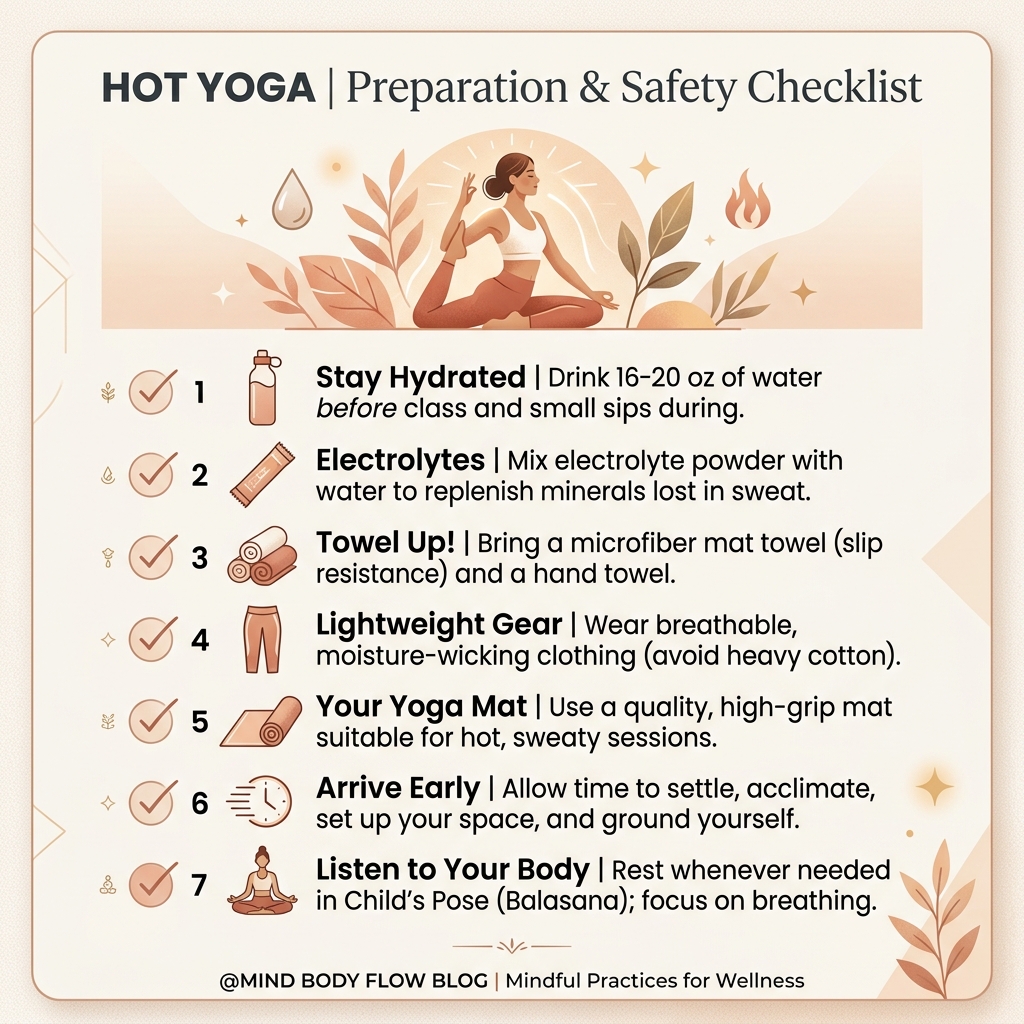
Hot Yoga Safety: Checklist & Risk Protocol
To help studio managers and students quickly reference safety protocols, here is a breakdown of common health conditions and the recommended safety action:
| Condition | Risk Level | Required Protocol / Action |
|---|---|---|
| First Trimester Pregnancy | Absolute Contraindication | Do not practice. Switch to prenatal room-temperature yoga. |
| Uncontrolled High Blood Pressure | Absolute Contraindication | Do not practice. Lower blood pressure before heated exercise. |
| Controlled Hypertension (Medicated) | Relative Risk | Requires doctor clearance. Monitor heart rate closely during transitions. |
| Type 1 / Type 2 Diabetes | Relative Risk | Keep glucose gel near mat. Check blood sugar before and after class. |
| Uhthoff’s (MS Heat Sensitivity) | Relative Risk | Practice near the door. Exit immediately if symptoms flare. |
| POTS / Orthostatic Issues | Relative Risk | Avoid rapid head level changes. Sit down when transitioning. |
Proactive Studio Safety: Tips for a Safe Heated Practice
If you have cleared all contraindications and are ready to practice, follow these rules to set yourself up for a safe, successful class:
- Hydrate 24 Hours in Advance: Do not try to hydrate by chugging water 10 minutes before class. This will just slosh in your stomach. Drink 2–3 liters of water the day before, and sip electrolytes before and after class.
- Practice Near the Door: If you are a beginner or have relative health risks, set up your mat near the exit. The air is slightly cooler there, and it allows you to step out easily if you feel overwhelmed.
- Listen to Your Breath: If you cannot maintain smooth, controlled nasal breathing, your body is working too hard. This is your cue to sit down on your mat and rest in Child’s Pose (Balasana) until your heart rate settles.
FAQ Section (At Least 4 Relevant FAQs)
How do we train studio staff to recognize the warning signs of heat exhaustion in clients during class?
In our studios, we train front-desk and teaching staff to look for visual cues like excessive flushed skin, glassy eyes, hyperventilation, or sudden loss of coordination during balance poses. If a student is sitting down repeatedly or looking disoriented, the instructor must quietly check on them and guide them to lie flat on their mat or exit to a cooler area.
Is hot yoga safe for individuals diagnosed with POTS (Postural Orthostatic Tachycardia Syndrome) if they modify poses?
Generally, we advise individuals with POTS to avoid hot yoga entirely because the high heat causes vasodilation, which lowers blood pressure and triggers a compensatory heart rate spike. If they have medical clearance, they must practice near the door at a lower temperature, avoid rapid vertical head movements, and focus on seated or supine postures.
Why is practicing hot yoga in the first trimester of pregnancy considered an absolute contraindication?
During the first trimester, the fetus is unable to regulate its own temperature, and maternal core temperatures exceeding 102.2°F (39°C) are linked to a higher risk of neural tube defects. Additionally, the pregnancy hormone relaxin is highly active, making joints excessively loose and increasing the risk of severe ligament strain under heat.
How should a studio owner handle a client who refuses to leave the room despite showing clear signs of heat distress?
Our studio policy mandates that student safety is non-negotiable; if a student exhibits signs of heat exhaustion, the instructor must calmly but firmly ask them to step out of the room to cool down. Instructors should explain that pushing through heat distress can lead to heat stroke, which is a life-threatening medical emergency.
Medical Disclaimer: This safety guide is for educational purposes only and does not replace professional medical advice. Always consult with your physician or a qualified healthcare provider before starting hot yoga, especially if you have pre-existing cardiovascular, endocrine, or neurological conditions. Exit the heated studio immediately if you experience dizziness, chest pain, or nausea.
Ready to Start Your Training?
Become a certified Hot Yoga teacher today. Explore our flexible training programs.