

How to Teach Hot Yoga Safely: A Certified Instructor’s Guide
In our studios, we’ve hosted over 50,000 practitioner hours in environments heated up to 105°F (40.6°C). Having spent the last fifteen years training and certifying new instructors, we’ve learned that teaching in a heated room is not just about calling out poses—it is about managing a highly dynamic, high-stress cardiovascular environment. A student’s physical safety is entirely in the hands of the teacher. If an instructor doesn’t know how to read the physiological signs of heat distress or fails to structure the climate control correctly, a beautiful class can quickly turn into a medical emergency. That is why understanding how to teach hot yoga safely is the absolute core skill of any professional hot yoga instructor. In this guide, we’ll outline the essential protocols for environmental management, student monitoring, and emergency response directly from the studio floor.
Teaching in heat changes the role of the teacher. In a standard room, a teacher can focus heavily on hands-on adjustments, complex alignments, and active physical demonstrations. In a hot room, however, your primary job is observation and verbal guidance. Because the heat increases blood flow, dilates blood vessels, and elevates heart rates, students will feel more flexible than they actually are, making them highly prone to over-stretching and muscle tears. At the same time, the risk of dehydration, heat exhaustion, and vasovagal syncope (fainting) is elevated. To keep your classroom safe, you must establish strict environmental standards and cultivate an acute eye for student distress.
1. Climate Control Standards: Managing Temperature and Humidity
The first line of defense when learning how to teach hot yoga safely is mastering the room’s environment. You cannot rely on a standard home thermostat; you must use commercial-grade sensors placed at student height. The safe environmental parameters vary by class style:
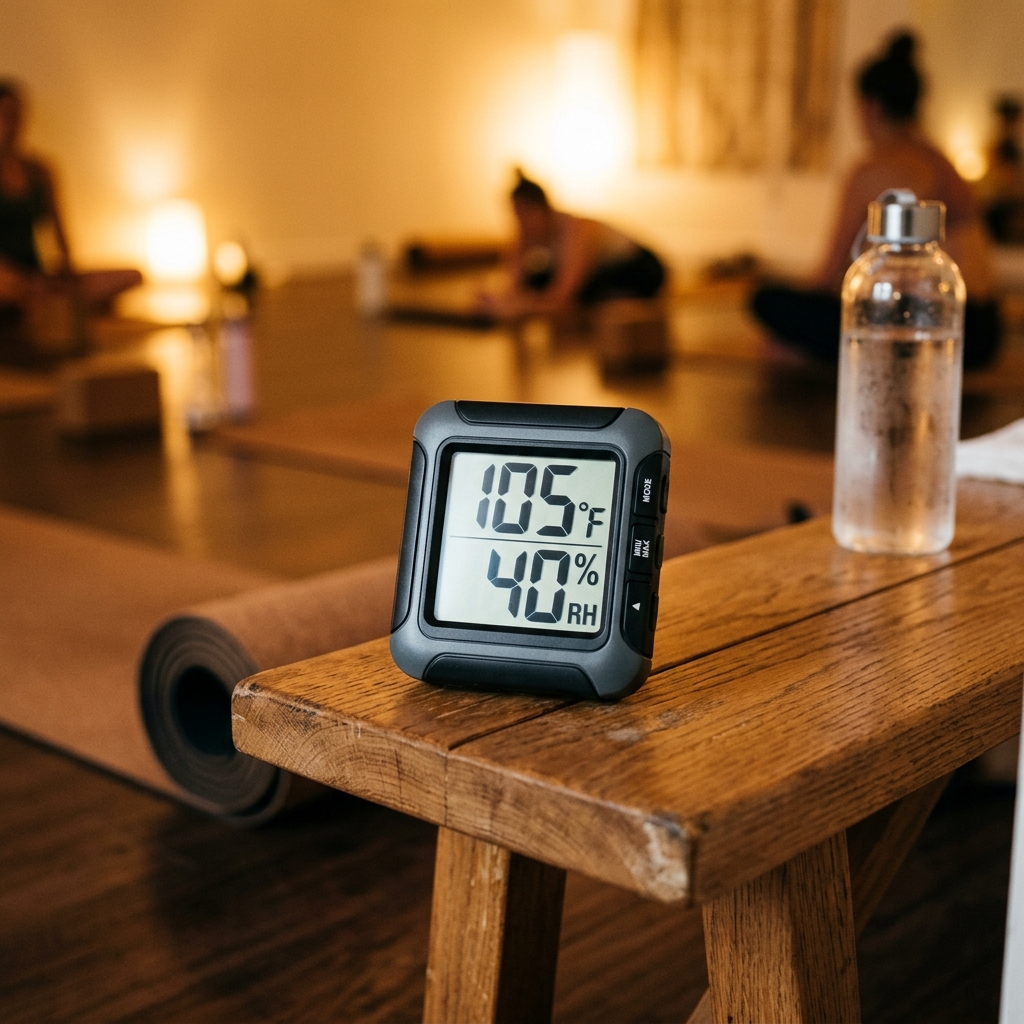
- Traditional Hot Yoga (26+2 / Bikram Style): Keep the room at precisely 105°F (40.6°C) with 40% relative humidity. Temperatures exceeding 108°F increase the risk of heat stroke exponentially.
- Hot Vinyasa / Power Flow: Maintain the temperature between 95°F and 98°F (35°C–40.6°C) with 50% to 60% relative humidity. Because the movement is more rapid and cardiovascular in vinyasa, the room must be slightly cooler than a static Bikram class.
- Hot Yin / Slow Flow: Keep the temperature between 85°F and 90°F (29.4°C–32.2°C). Because postures are held passively for long durations, higher temperatures can cause dangerous ligament laxity.
Instructors must also monitor carbon dioxide (CO2) levels. In a sealed room with 40 students breathing heavily, CO2 can quickly spike, causing dizziness and panic. Ensure your studio is configured with a ventilation system that purges air or introduces fresh air periodically throughout class without dropping the temperature too rapidly.
2. Pre-Class Screening: The Doorway Assessment
Your safety protocol begins before anyone unrolls a mat. Instructors should always stand at the entrance to the hot room to greet students and perform a quick visual and verbal assessment. Use this time to identify potential risks:
- Identify First-Timers: Ask if anyone is new to practicing in the heat. Place newcomers near the back of the room, away from the direct blast of the heaters, and close to the exit door in case they need to leave.
- Ask About Hydration: Ask newcomers if they have consumed at least 2 liters of water today. If they admit they haven’t eaten or drank anything all day, advise them to take it very easy or offer them electrolyte water before class begins.
- Check for Medical Contraindications: Verbally remind the class about safety. If a student is pregnant, has a history of high or low blood pressure, cardiovascular conditions, or is taking medications that affect thermoregulation, they must have medical clearance. (Refer to our comprehensive guide on who should not do hot yoga).
3. Physiological Warning Signs: Spotting Heat Distress
During class, you must keep your eyes on the students, not on your own mat. Walk around the room and look for the classic signs of heat distress. If you observe any of the following, prepare to intervene immediately:
- The Glassy Look: A student who is staring blankly into space, struggling to follow simple cues, or failing to make eye contact. This is an early sign of heat exhaustion and mental confusion.
- Extreme Flushing or Sudden Pallor: A bright red face is normal, but a student who suddenly turns pale, white, or ash-gray is about to faint due to a drop in blood pressure.
- Anhidrosis (No Sweating): If a student has been sweating heavily and suddenly stops sweating while their skin remains hot and dry, this is a medical emergency. It indicates their thermoregulation system has failed, leading toward heat stroke.
- Unsteady Balance or Stumbling: A student who is swaying, losing their footing in basic standing poses, or trembling excessively.
- Hyperventilation: Rapid, shallow, audible breathing through the mouth. Teach students to return to steady nasal breathing to calm the nervous system.
4. Verbal Cueing and De-escalation
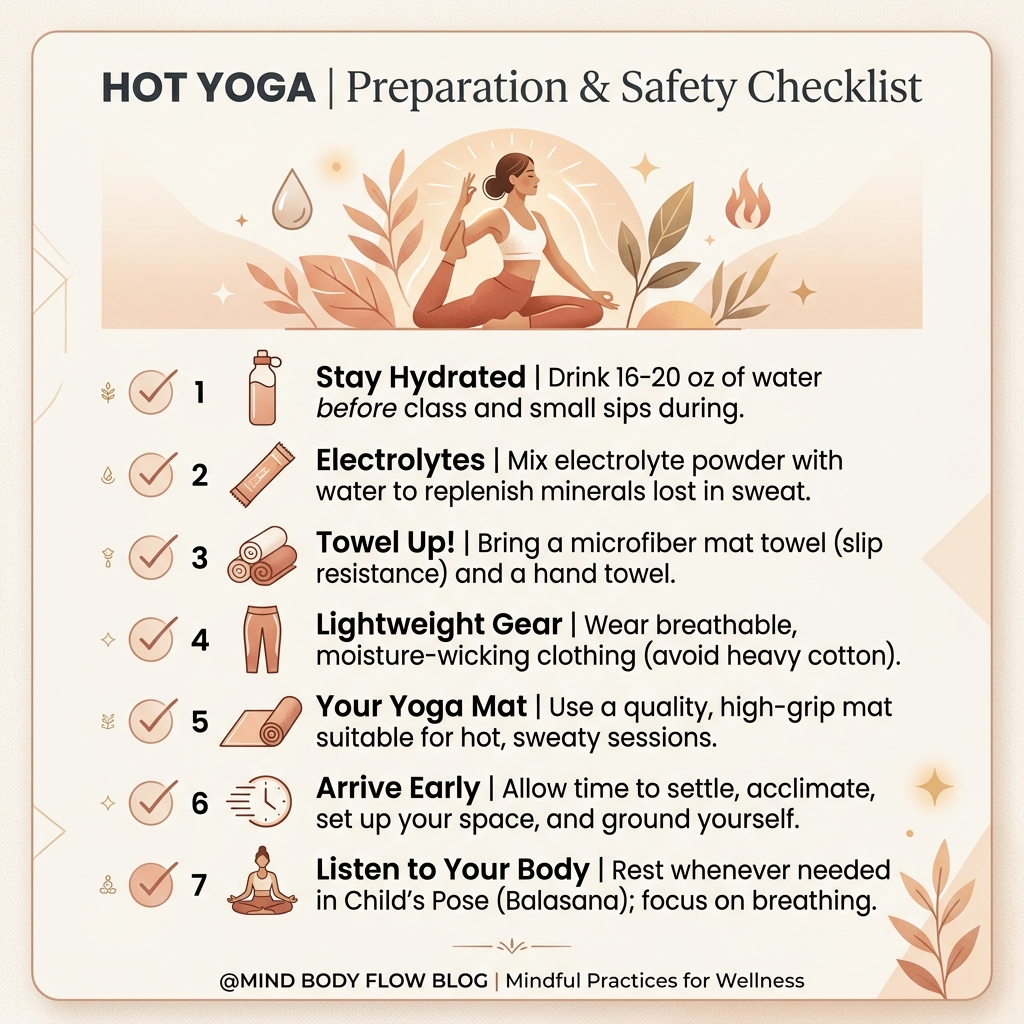
To teach hot yoga safely, you must change the language you use. Traditional fitness classes encourage students to “push through the pain” or “find their limits.” In hot yoga, you must actively de-escalate this mindset. Use these cueing best practices:
Explicitly Normalize Rest: At the start of every class, state clearly: “Your ego does not belong in this room. If at any point the heat feels overwhelming, your heart is racing, or you feel dizzy, immediately come down to Child’s Pose or sit quietly on your mat. The air is up to ten degrees cooler close to the floor. Do not wait for me to tell you to rest.”
Offer Modifications Consistently: For every challenging posture, offer a lighter variation. Remind students that holding a basic shape with steady breathing is infinitely more beneficial than forcing a peak expression while gasping for air. Encourage students to check their gear, perhaps ensuring their mats are kept slip-free with a premium towel, as reviewed in our guide on the best hot yoga towels.
Hot Yoga Safety Parameter Matrix
To help instructors maintain safety, here is a quick-reference guide for environmental and student parameters:
| Parameter | Target Safe Level | Risk Level (Monitor Closely) | Action Required |
|---|---|---|---|
| Room Temperature | 95°F – 105°F (35°C–40.6°C) | 106°F – 108°F | Turn off heaters; turn on fresh air ventilation immediately |
| Relative Humidity | 40% – 50% | Above 60% (Stifles sweat evaporation) | Activate exhaust fans to pull out excess humidity |
| Student Skin Color | Normal flush / red | Ashen gray / pale | Have student lie down, elevate feet, apply cool towel |
| Student Sweat State | Continuous sweating | Dry skin / hot touch | Immediate medical attention (suspected heat stroke) |
FAQ Section (4 Target FAQs for Teachers)
How do we train instructors to respond to a student who refuses to rest when showing signs of heat exhaustion?
In our training, we teach instructors to use quiet, individual de-escalation. Walk over to the student’s mat, crouch down to their eye level, and speak quietly: ‘I notice you are breathing very rapidly and looking slightly dizzy. For your safety, I need you to take a breath and sit in Child’s Pose for the next sequence. I’ll check on you in two minutes.’ Never call out or embarrass a student publicly, but do not hesitate to enforce a safety rest.
Why is carbon dioxide accumulation more dangerous in a heated yoga studio than a standard room?
Under high temperatures and physical exertion, the body’s respiration rate increases, consuming oxygen and releasing carbon dioxide at an accelerated rate. If a studio lacks proper ventilation, CO2 builds up, which triggers the brain’s suffocation alarm, leading to artificial hyperventilation, dizziness, panic attacks, and severe headaches among students.
What are the absolute medical contraindications that should prevent a student from participating in a heated class?
Absolute contraindications include advanced cardiovascular disease, unstable high or low blood pressure, severe autonomic nervous disorders, acute kidney disease, active fevers, and pregnancy (unless cleared by an OB-GYN and highly experienced in heat). Instructors must screen for these before class and direct students to regular, non-heated classes.
Should a hot yoga teacher walk around the room or stay on a podium to teach safely?
We always recommend that instructors teach from a elevated podium or walk the perimeter rather than practicing along with the class. When an instructor is physically practicing in 105°F heat, their own cognitive capacity decreases and their eyes are on their own mat. To keep the room safe, the teacher must remain cool, hydrated, and fully focused on observing the students’ alignment and vital signs.
Medical Disclaimer: The information in this article is for educational and informational purposes only. Practicing hot yoga increases cardiovascular strain and core temperature. Consult a medical professional before starting home hot yoga if you have heart conditions, blood pressure issues, autonomic nervous disorders, or if you are pregnant. Exit the heated room immediately if you experience dizziness, nausea, or lightheadedness.
Ready to Start Your Training?
Become a certified Hot Yoga teacher today. Explore our flexible training programs.