
How to Choose a Hot Yoga Towel: The Complete Buyer’s Guide
In our studios, we’ve watched countless beginners unroll beautiful mats, only to spend the next 60 minutes sliding, slipping, and adjusting their towels in frustration. Having spent the last decade managing heated rooms and teaching back-to-back classes in 105°F environments, I’ve learned that a student’s gear can make or break their practice. If you are struggling to keep your balance in Downward Dog because your hands are sliding forward, you aren’t building strength—you’re just fighting your equipment. That is why knowing how to choose a hot yoga towel that matches your specific mat, sweat level, and practice style is essential. In this comprehensive guide, we’ll walk you through the key factors of fabric technology, stability systems, sizing, and care to help you select the perfect grip barrier.
With dozens of options available, from textured silicone-nubbed overlays to smooth suede-like microfiber sheets, selecting a towel can feel overwhelming. Many buyers make the mistake of choosing a towel based solely on color or price, ignoring the underlying fabric mechanics. In reality, different materials behave completely differently depending on whether you are a light or heavy sweater, and whether your mat is made of natural rubber, PVC, or polyurethane. Let’s break down the essential decision parameters to help you buy with confidence.
1. Grip and Stability Systems: Skidless vs. Friction-Based
The first and most critical choice when learning how to choose a hot yoga towel is selecting the stabilization mechanism. A towel is useless if it slides around on top of your mat. There are two primary systems designed to keep towels in place:
Silicone-Nubbed (Skidless) Towels
Silicone-nubbed towels (like the Manduka Yogitoes) feature hundreds of small, soft silicone dots heat-pressed onto the underside of the towel. These dots act as miniature anchors that grab the top surface of your yoga mat. Here are their pros and cons:
- Pros: Absolute stability. The towel will not bunch, slide, or move during jump-backs, lunges, or rapid transitions. It performs exceptionally well on textured PVC or natural rubber mats.
- Cons: Some practitioners find the texture of the silicone nubs under their hands and feet distracting or slightly uncomfortable during long, passive holds. They are also heavier and more expensive.
Friction-Based (Smooth Microfiber) Towels
Friction-based towels (like the Manduka eQua or Lululemon The Towel) rely on the natural coefficient of friction between the wet fabric fibers and the mat surface. They have a completely smooth, suede-like or plush texture. Here are their pros and cons:
- Pros: Extremely comfortable and soft to the touch. They are lightweight, highly packable, and double as great travel mats.
- Cons: If your mat has a very smooth surface (like a polyurethane mat), a smooth towel may slide slightly when dry. It requires moisture to activate its grip, so you must mist it with water before the start of class to lock it in place.
2. Fabric Technology: Understanding Microfiber Performance
Almost all modern hot yoga towels are made of polyester-nylon microfiber blends rather than cotton. Microfiber is chosen because of its unique capillary structure, which pulls moisture deep into the core of the fibers. This serves two key purposes during a sweaty class:
- Capillary Action: As sweat pools on your skin and mat, the microfiber channels it away, keeping the surface dry and grippy. Microfiber towels can absorb up to five times their weight in liquid.
- Tackiness Activation: Microfibers are structurally engineered to become ‘tacky’ and high-friction when wet. Unlike cotton, which becomes heavy and slick when waterlogged, microfiber increases its grip the wetter it gets.
When selecting a microfiber towel, look at the pile (thickness). A thin, suede-like microfiber is lightweight and has a fast drying time, but offers minimal cushioning. A thicker, plush microfiber towel provides extra joint support for your knees and wrists during floor postures, but will hold onto moisture longer and take longer to dry post-practice.
3. Sizing and Mat Compatibility: Full-Length vs. Hand Towels
Size compatibility is another essential factor when choosing a towel. To prevent bunching and protect your mat, the towel should match the length and width of your yoga mat as closely as possible:
- Standard Size (68″ x 24″): Fits standard yoga mats. If your towel is too small, your hands or feet will slip off the edge onto the slick mat during wide stances. If it is too large, the excess fabric will drape over the edges, catching your feet and causing a tripping hazard.
- Extra-Long (72″ x 26″ or 85″ x 26″): Designed for extra-long and extra-wide mats. Check your mat’s dimensions before buying.
- Hand Towels (16″ x 24″ or 16″ x 16″): Excellent for keeping next to your mat to wipe sweat from your face, eyes, and hands between sequences. While a hand towel can be placed at the front of your mat for hand grip, it does not provide slip protection for your feet in postures like Downward Dog.
4. Anchor Systems: Corner Pockets and Elastic Straps
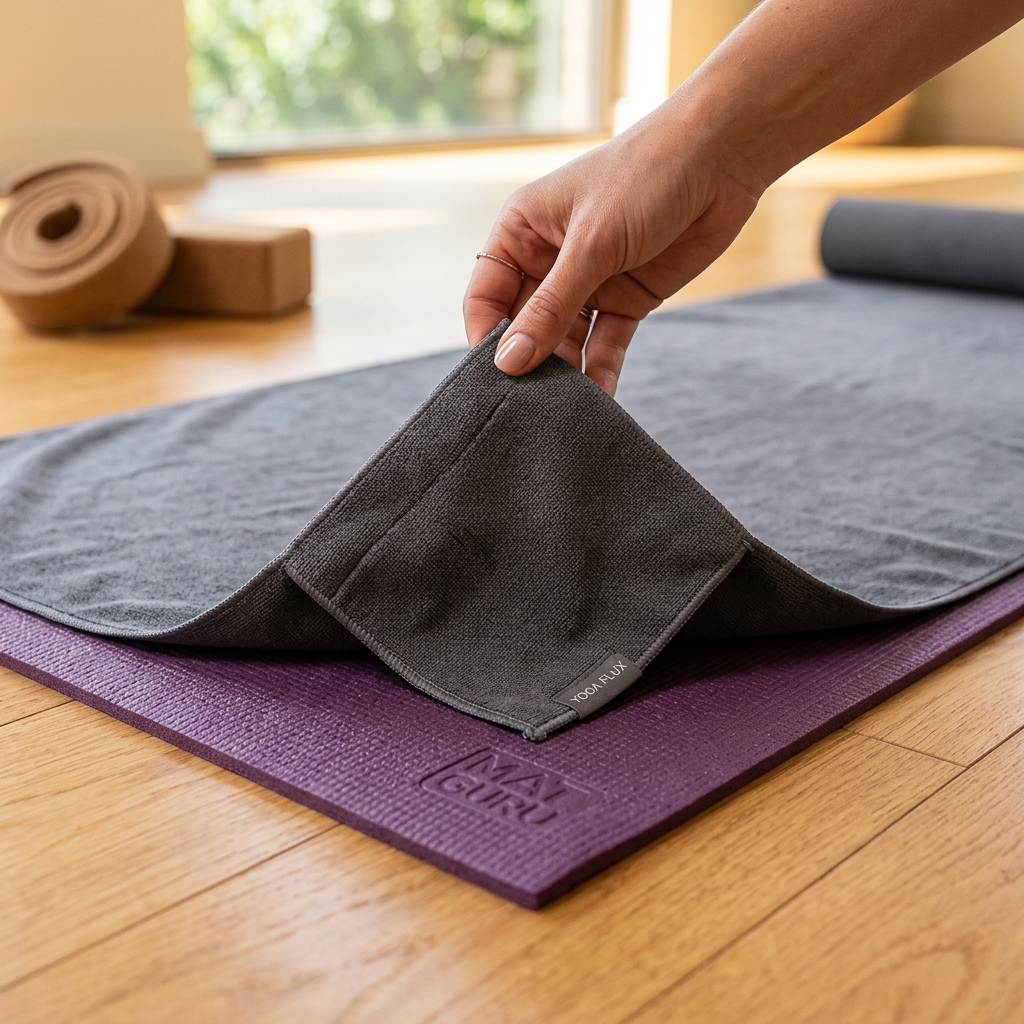
To solve the issue of smooth microfiber towels sliding on the mat, several manufacturers have introduced integrated anchor systems. These include:
- Corner Pockets: The towel features four fabric pockets on the underside corners that slip over the corners of your yoga mat, anchoring the towel flat. This completely eliminates bunching during standing flows.
- Elastic Straps: Heavy-duty elastic bands on the corners of the towel that wrap under the mat, keeping it taut.
If you prefer a smooth, nub-less microfiber towel but practice an active, flowing style of hot yoga (like Hot Vinyasa or Power Yoga), choosing a towel with corner pockets is highly recommended to keep your practice frustration-free.
Yoga Towel Decision Matrix
To make the selection process simple, here is a quick reference decision matrix based on your mat material and sweat volume:
| Mat Material | Sweat Volume | Recommended Towel Type | Key Reason |
|---|---|---|---|
| Textured PVC / Rubber | Heavy Sweat | Silicone-Nubbed (Skidless) | Nubs lock into mat texture for maximum stability |
| Smooth Polyurethane (PU) | Moderate to Heavy | Suede Microfiber (Nub-less) | Friction-based cloth clings to smooth PU surfaces best |
| Textured PVC / TPE | Light to Moderate | Microfiber with Corner Pockets | Anchors keep the towel flat even when dry/light sweat |
| Any Mat | Any (Travel Use) | Ultra-thin Suede eQua Style | Lightweight, fast-drying, easy to pack |
FAQ Section (At Least 4 Relevant FAQs)
How do we train instructors to explain the difference between damp-activated grip and dry grip to beginners?
In our studios, we train instructors to teach beginners that premium microfiber towels work like climbing chalk—they require moisture to activate their grip. Instructors should advise students to lightly mist the hand and foot areas of their towel with water before class starts to prevent slipping during the warm-up before they begin sweating.
What is the most effective commercial washing protocol to keep studio rental towels from losing their grip?
To maintain the absorbency and tackiness of microfiber hot yoga towels, they must be washed in cold or warm water using a mild, liquid detergent, and dried on low heat. Never use fabric softeners or dryer sheets, as they leave a thin chemical coating on the fibers that clogs the weave and makes the towel extremely slippery.
Why do some clients complain that their silicone-nubbed towels slide on polyurethane (PU) mats?
Polyurethane mats (like the Lululemon 5mm or Liforme) are designed for dry and wet grip without a towel, and their smooth surface does not friction-lock with silicone nubs as well as textured rubber or PVC mats. If a client is using a PU mat, recommend a smooth microfiber towel like the Manduka eQua, which relies on fabric-on-mat friction rather than silicone dots.
Should a studio recommend full-length towels or hand towels for hot yoga beginners?
We always recommend a full-length mat towel for hot yoga beginners to cover the entire mat surface, protecting the mat from sweat and providing uniform slip protection. Hand towels are a useful supplement for wiping sweat from the face and hands during rest breaks, but they do not prevent slipping during active standing postures.
Medical Disclaimer: The information in this article is for educational and informational purposes only. Practicing hot yoga increases cardiovascular strain and core temperature. Consult a medical professional before starting home hot yoga if you have heart conditions, blood pressure issues, autonomic nervous disorders, or if you are pregnant. Exit the heated room immediately if you experience dizziness, nausea, or lightheadedness.
Ready to Start Your Training?
Become a certified Hot Yoga teacher today. Explore our flexible training programs.